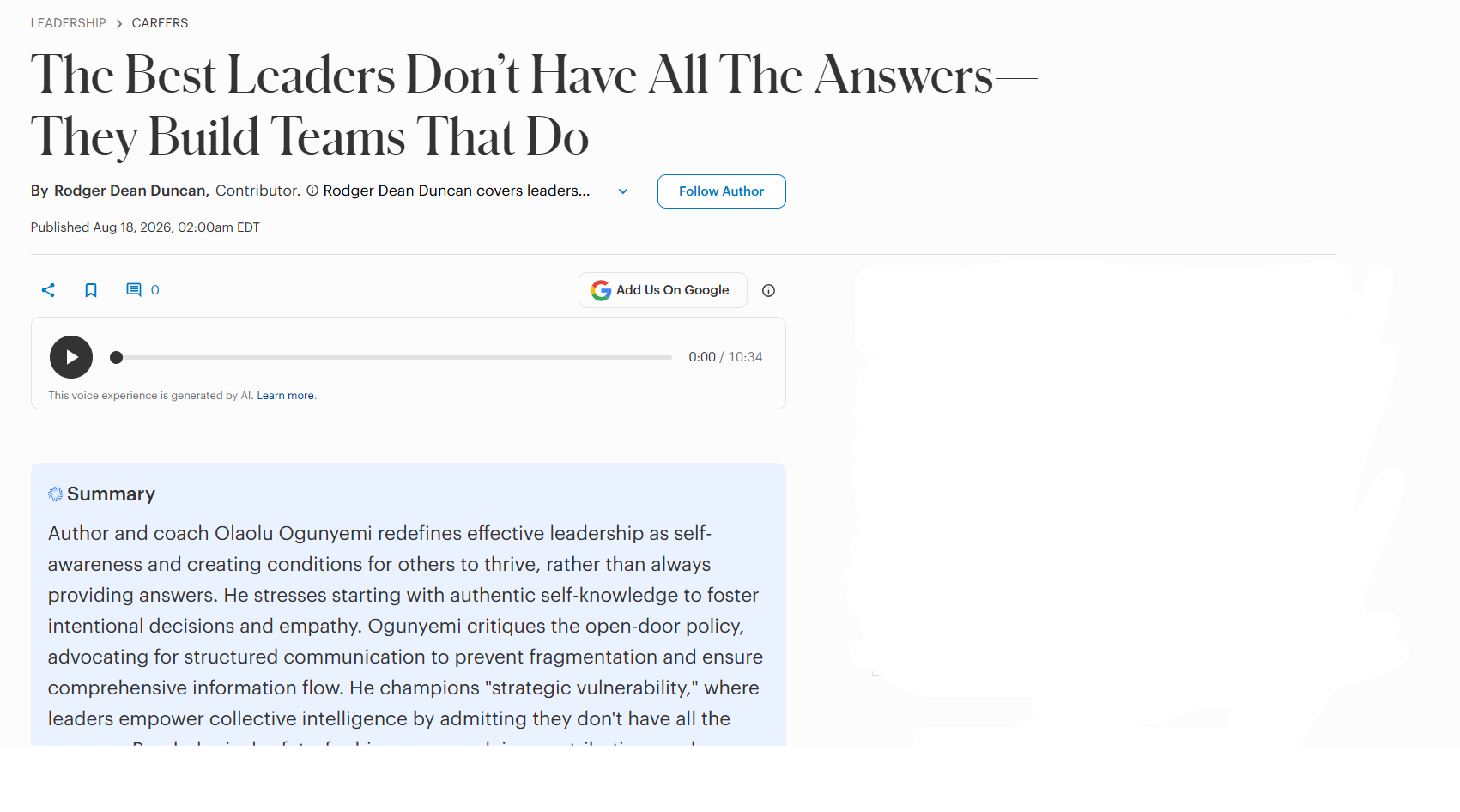

I’m honored, excited, and pumped up to share that my leadership principles are featured in Forbes! The Lead Last framework keeps gaining momentum as leadership evolves. The old model of the leader who has all the answers is fading fast. Today’s most effective leadership principles center on something far more powerful: building an environment where people think, contribute, experiment, and grow.
That’s the heart of the Forbes feature highlighting my book. Dr. Rodger Dean Duncan describes what happens when leaders stop performing and start creating conditions where teams thrive.
This is another huge milestone for me, and I’m honored to share it with the Parent-Child-Connect community. Without rehashing the full article (seriously, you have to read it for yourself), let’s talk about some key highlights.
Leadership starts with identity
Before we talk strategy or performance, leadership begins with a simple but often overlooked question: Who are you?
High performers can get attached to the polished version of themselves that produces results. But real leadership requires reconnecting with your authentic identity. When leaders understand who they are at their core, they make more intentional decisions, build stronger relationships, and create environments where people feel seen.
As I shared in the interview:
“Beginning with an in-depth understanding of who we are creates the foundation for more intentional decisions and interactions.”
Self-awareness is not optional. It’s the starting point.
Intentional communication beats constant availability
The open-door policy is one of the most praised leadership practices. It signals accessibility and connection. But as I explained in the feature, it can also create unintended consequences.
When anyone can interrupt at any time, leaders lose focus. And only a small group of people usually take advantage of that open door, which means leaders get an incomplete picture of what’s happening.
The solution isn’t isolation. It’s intentionality.
Leaders don’t need to be available every minute. They need communication systems that help the entire team stay aligned.
Strategic vulnerability unlocks collective intelligence
One of the most powerful moments in the feature comes from a story about Donnie Smith, former CEO of Tyson Foods. Instead of relying on his expertise, he looked around the room and said:
“The answer is in the room.”
That’s what I call “strategic vulnerability,” not weakness. It’s leadership that invites contribution and distributes ownership. When leaders stop trying to be the source of every solution, they create space for collective intelligence to emerge.
Psychological safety is about connection, not comfort
Psychological safety is often misunderstood as making the workplace comfortable. But as I shared in the feature, it’s not about eliminating standards or avoiding tough conversations. It’s about helping people feel connected to something bigger than themselves.
When people believe their contributions matter, they engage. And engagement drives performance. Gallup’s research shows that highly engaged teams deliver:
- 23 percent higher profitability
- 70 percent higher well-being
- 63 percent fewer safety incidents
Encouragement is fuel.
Big goals need small steps
Ambition inspires people, but it can also overwhelm them. That’s why I teach leaders to break big goals into manageable increments.
Define the long-term goal, identify the 90-day milestones, build daily habits that move one milestone at a time, measure weekly, and adjust intentionally.
Momentum beats anxiety every time.
As I shared in the feature:
“Anxiety is usually the result of trying to accomplish too much at once instead of focusing on the daily repeatable processes that will lead to accomplishing your goal.”
Empowerment requires boundaries
Empowerment doesn’t mean giving people maximum autonomy on day one. It means giving them the right-sized pot so they can grow. Boundaries channel energy. As competence increases, autonomy expands.
This is calibrated empowerment.
Failure is part of innovation
SpaceX is a perfect example of what happens when organizations normalize intelligent risk. Leaders who punish every mistake suffocate creativity. Leaders who tolerate measured failure unlock innovation.
As I shared in the feature:
“If your team isn’t failing publicly, either they’re scared to fail, or your goals aren’t big enough.”
Innovation requires courage, and leaders set the tone.
This feature is a celebration of the mission
Being featured in Forbes is more than a personal win. It celebrates the mission behind Parent-Child-Connect. It’s proof that intentional leadership resonates across industries, communities, and generations.
Leadership is not about having all the answers. It’s about creating an environment where people can contribute, take intelligent risks, stay focused on meaningful goals, and feel connected to a purpose bigger than themselves.
That’s how we build leaders at home, at work, and in the world.
And that’s how we Lead Last!
Read the full article here: The Best Leaders Don’t Have All The Answers—They Build Teams That Do
Leave a Reply