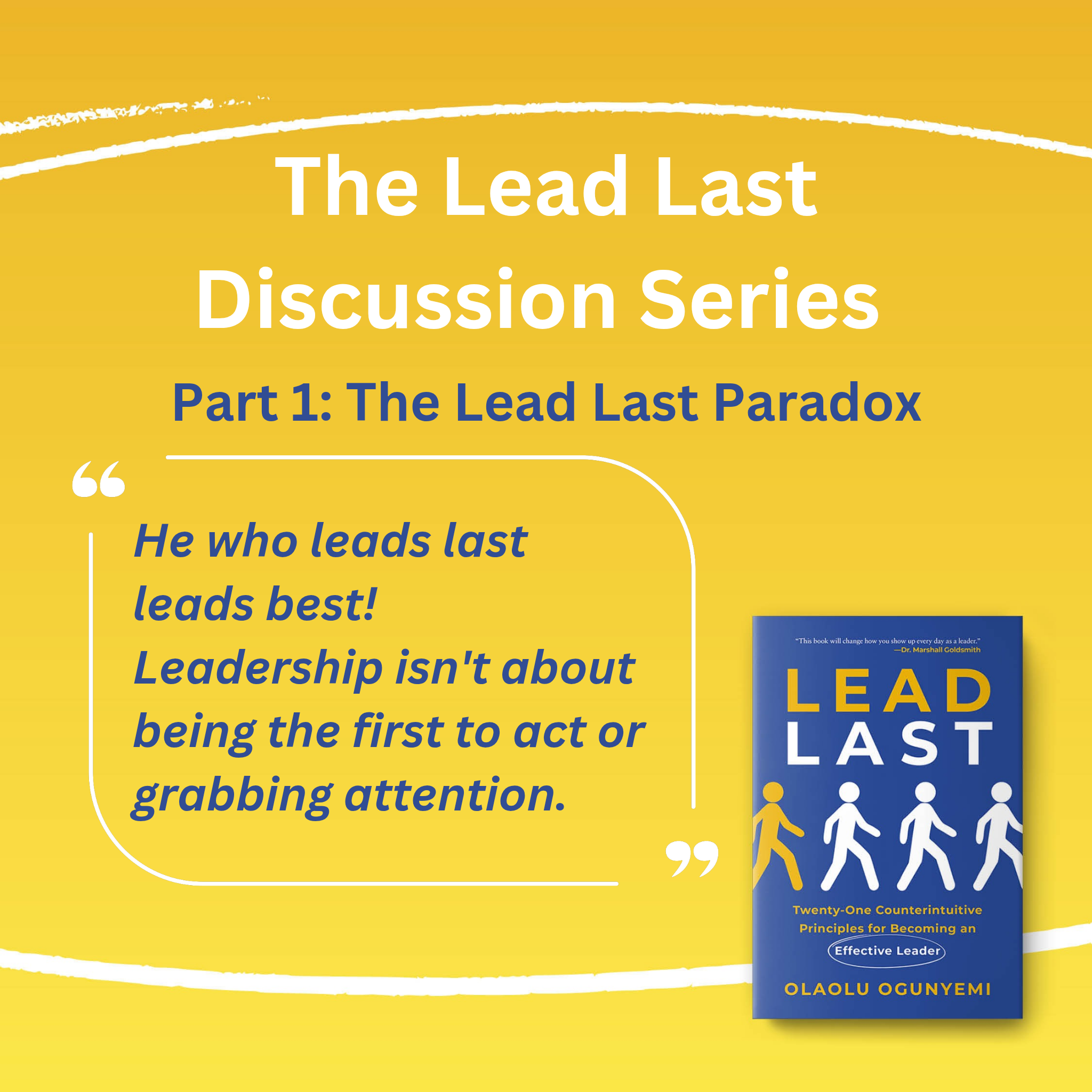

Over the next few weeks, I’m going to spend some time discussing key points from my latest book, Lead Last. I’m calling this a “discussion series” because I want to hear from you, the people actually leading every day.
Today, let’s discuss the premise and paradox of the “Lead Last” concept.
“He who leads last leads best! Leadership isn’t about being the first to act or grabbing attention.”
Why is this counterintuitive?
In almost every professional setting, we are taught that “taking charge” means being the first to speak, the first to offer a solution, and the most visible person in the room. We equate speed with strength and noise with authority. To many, the idea of “leading last” sounds passive, slow, or even like a lack of initiative. I laughed when one of my colleagues texted, “Leading last sounds like you don’t lead unless you really have to.” With all that in mind, I knew I’d have to do some explaining to make sure the concept doesn’t get lost in translation.
The Philosophy:
When I talk about “Leading Last,” I am using a triple entendre that challenges the very foundation of how we manage people.
First, it is about sequence. It is the discipline to be the last to speak. When you speak first, you set a ceiling for your team and encourage them to echo your thoughts rather than think for themselves. By waiting, you become the architect of the conversation, gathering all the intelligence in the room before making an informed decision.
Second, it is about preparation. You cannot effectively lead last if you haven’t done the work first. Leading last requires an in-depth understanding of three things: who you are, who you are leading, and the culture you are influencing. If you haven’t mastered your own character and understood your team’s unique motivations, “leading last” is just hesitation/apprehension. You must do the heavy lifting of self-awareness and relationship-building before you can earn the right to lead from the back.
Third, it is about durability. True leadership is measured by what happens when you aren’t in the room. When you lead last, you aren’t building a cult of personality; you are building a legacy of mentorship. You are ensuring your influence lasts long after your tenure ends by empowering others to own the mission.
The Connection:
One of the most common questions I’ve received is regarding whether there’s a connection between my concept and the groundwork Simon Sinek laid in Leaders Eat Last. Sinek’s work is a masterclass in the heart of leadership and the biological necessity of sacrifice. He correctly identifies that a leader’s job is to provide safety.
Lead Last takes that sacrifice and turns it into a strategy. While “eating last” is a gesture of care, “leading last” is a method for growth. Sinek focuses on how a leader provides; I am focusing on how a leader prepares themselves and their team so that the excellence of the organization is sustainable and permanent.
The Debate:
Is your leadership designed to make you look good now, or to make the team succeed later? If you weren’t allowed to speak until the very end of your next meeting, would your team know exactly what to do, or would the room fall silent?
Let’s talk about it in the comments. Is “leading last” a strategy for the confident, or an excuse for the hesitant?
Leave a Reply